 Tufted
Apple Bud Moth, Platynota idaeusalis (Walker)
Tufted
Apple Bud Moth, Platynota idaeusalis (Walker)II. Hosts: The major hosts of the TABM include: apple, pear, peach, nectarine, cherry and a wide range of herbaceous plants found in the ground cover.
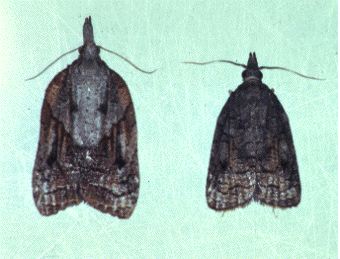
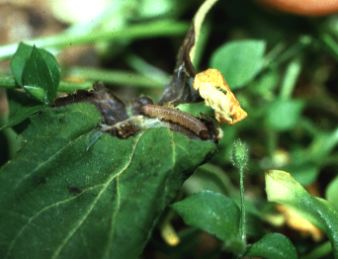
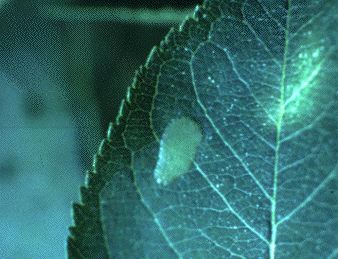
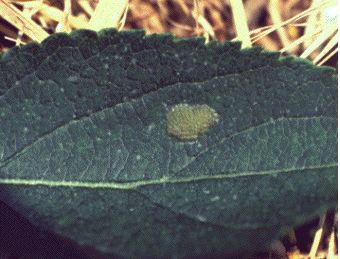
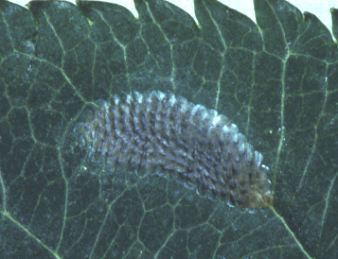
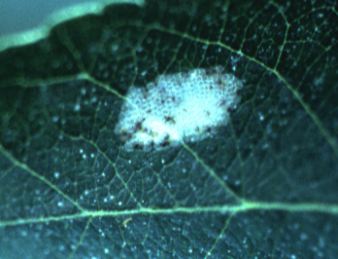
III. Description: The adult female moth is approximately 1/2 inch (13 mm) long, with the males being slightly smaller. The moths are inconspicuous in color, varying from a mottled gray to brown (Plate 14). The coloration of the wings is generally one-third grayish at the wing base, with gradually darkening to brown at the wing tips. There is usually a lighter colored margin along the leading edge of the wings. The moth is named after the tufted scales which can be seen as two or three groups on the tops of the wings. The larvae are a light brown to grayish tan with a chestnut brown head capsule, a darker prothoracic shield (hardened area between the head and the body), and a dark stripe down the back of the body. A full grown larva is approximately 3/4 inch (18-20 mm) long (Plate 15). TABM deposit their eggs in a flattened, ovoid, green mass consisting of upwards to 150 eggs (Plate 16). As the egg mass matures it changes from a green to a bronze color and finally to a black-head stage which occurs within 24 hours of hatch (Plate 17). Egg masses usually hatch within 8 to 10 days of being deposited. The egg mass is always deposited on the upper leaf surface.
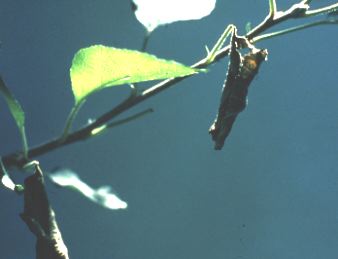
IV. Biology: TABM produce two generations a year with larvae overwintering as second through fifth instars in larval shelters such as rolled leaves and decaying fruit. These shelters are located beneath trees in apple, cherry, peach, nectarine and pear orchards. The larvae become active in early spring, and complete development on a variety of host plants (e.g., root suckers, dandelion, dock, and wild strawberry). The larvae pupate and begin emerging as adults about the beginning of May. They begin egg-laying anywhere from mid- to late May. The peak hatch period occurs about mid-June First instar larvae disperse by crawling or ballooning (floating in the wind on a strand of silk). First and second instars then feed along a leaf midrib, and, beginning with the third instar, they create shelters by rolling leaves after notching petioles (Plate 18), tying leaves to other leaves or fruit, and by building shelters within fruit clusters. Larvae generally pupate within these shelters, emerge as adults, and begin second brood egg-laying about the beginning of August. Peak egg laying and hatch occur in mid- to late August. Late season second brood larvae (second through fifth instars) drop to the ground during fruit harvest or with leaf fall to overwinter. Larvae are attacked by a number of parasitoids, the most common being an ichneumonid, Exochus atriceps Walsh, and an braconid, Meteorus trachynotus Viereck.
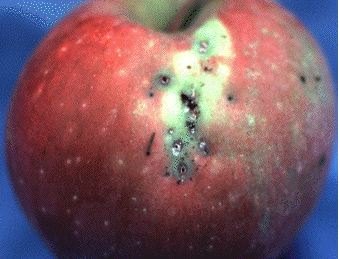
V. Injury: The TABM belongs to a family
of
moths known as leafrollers, but the leafrolling activity has
little
economic
impact on the fruit grower and little physiological impact on
the tree.
It is when this insect webs a leaf onto the apple fruit and
feeds
directly
on the fruit that it becomes a pest. This damage appears as tiny
holes
(early instar feeding), as irregular scarring or channeling of
the
apple
surface (Plate 19), or as an area of rot, generally found around
the
stem.
Rot or corking around the stem occurs usually after the larvae
have
finished
feeding and have pupated. Larvae occasionally enter the apple
calyx and
feed unnoticed within the seed cavity. Most injury to apples is
caused
by second brood feeding, although in some years first brood
damage can
exceed damage caused by the following generation. Injury to
fruits
destined
for fresh markets has a greater economic impact since their cash
value
is much higher compared to that of processing grade apples.
Generally,
TABM injury does not reduce the grade of processing apples, but
it can
affect the rate of fruit drop and storageability of those apples
by
promoting
decay, both of which can have an economic impact on the grower
and
processor.
Monitoring: Recent research at Penn
State
University has revealed a relationship between the number of
adult male
TABM caught in sex pheromone
traps in the spring and apple injury at harvest. This
relationship
was developed from orchards treated with an average of four
alternate-row
middle sprays applied for each brood (June and August). In order
to use
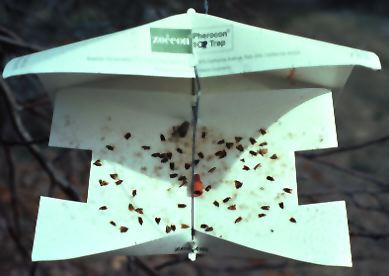
this monitoring method, a wing-style sex pheromone trap is
needed. Two
traps are recommended for every 10 acres (4 hectares) or less of
`Delicious'
or `Yorking'. Traps should be placed at petal fall, at least 200
yards
(185 m) apart and in trees located in the center of the block.
They
should
be attached to a limb at a height of 5-6 ft (1.5-1.8 m) in the
outer
third
of the tree's canopy and in the orchard by May 1. Check traps
every day
until the first TABM adult is caught, and record this date,
after which
the traps should be checked once a week. After the first
sustained
capture
of TABM, maintain the above procedures for 3 weeks unless cool
temperatures
occur which affect male flight. If cool temperatures occur after
first
trap catch add one additional week of trap capture. At the end
of the
3-week
period average the number of moths caught in each trap to
determine a
mean
cumulative total per trap for the entire block.
Penn State University researchers also found a
relation
between the amount of fruit injury caused by larvae of the first
generation
and the amount of fruit injury at harvest (Table 1). In order to
estimate
this relationship, growers should select 10 trees of a TABM
sensitive
cultivar
(e.g., `Yorking', `Stayman', Rome Beauty') which are
representative of
tree size and crop load in the orchard. Examine 100 apples per
tree (50
top and 50 bottom) during late July or early August. Then
calculate the
percentage of apples having TABM injury and use Table 1 to
determine
the
amount of injury to expect from the second generation. If the
percentage
of first brood injured apples does not equal one of the values
in Table
1, it can be inserted into the equation at the bottom of Table 1
and
the
amount of harvest damage determined. For example, if first brood
fruit
injury is 3.5%, the amount of harvest injury is 7.4% (7.4% =
2.22 +
1.47X[3.5%]).
Figure 5 can be used to find the amount of expected fruit injury
for
the
cumulative total number of moths caught during the sampling
period. If
the projected fruit injury is too high for intended markets,
then a
variety
of adjustments should be considered to improve the effectiveness
of the
spray regime [i.e., 1) improve spray coverage by increasing the
volume
of water used, 2) shorten the spray interval between complete or
alternate
row (ARM) sprays (e.g., 5 ARM sprays/brood), or 3) increase
insecticide
rates. If the cumulative trap catch is considerably below an
acceptable
level of injury, then decrease the number of complete or ARM
sprays
(e.g.
3 ARM sprays/brood) and/or insecticide rate. If the number of
sprays is
to be decreased, it is safer to reduce first brood sprays rather
than
second
brood sprays. Similar adjustments can be made if the grower is
using
first
brood fruit injury as an indicator of fruit injury at harvest.
Insecticide applications are timed for the egg hatch period since the young larvae are the most susceptible stage for control. Based on recent work by Penn State University researchers if insecticide applications are needed for first brood control they should be applied at about 10% egg hatch which occurs 530-585 DD and second application at 805-855 DD (base 45 degrees F) from the first sustained trap capture of males in sex pheromone traps. These recommendations are based on applying complete sprays. For growers using the alternate row middle system, applications should commence 50-75 DD earlier, at about 475 DD after first trap capture and then repeated every 7 days for a total of four ARM applications per brood depending upon insect density.
If using Intrepid and SpinTor: for first brood control, these products should be applied as a complete spray at 585-640 DD from biofix (base 45ºF, Table 22), or as two alternate-row-middle applications 7 days apart beginning at 530 DD. An additional application may be needed (in 14 days for complete, in 7 and 14 days for alternate-row-middle) in high pressure situations.
Table 1. Predicted brood II TABM fruit
injuries
estimated from the percentage of brood I injury.
| % Brood I Injury1 | Predicted % Brood II Injury | Expected limits of % Brood II Injury2 |
| 0.5 | 3.0 | 2.40-3.60 |
| 1.0 | 3.7 | 3.13-4.27 |
| 1.5 | 4.4 | 3.83-4.97 |
| 2.0 | 5.2 | 4.61-5.79 |
| 3.0 | 6.6 | 5.88-7.32 |
| 4.0 | 8.1 | 7.22-8.98 |
| 5.0 | 9.6 | 8.51-10.69 |
For timing of second brood applications, sprays should be applied after an accumulation of 2280-2355 DD (base 45 degrees F) from first sustained trap capture of the first brood or 530 DD from first trap capture of second brood moths. Again, a second application should be applied 300 DD after the first application for second brood control. ARM applications of insecticides should precede the above DD accumulation by 50-75 DD. Additional insecticide applications may be needed for second brood control since the egg hatch period for second brood extends over a 650 DD period; whereas, the egg hatch period occurs over a 300 DD period.
For second brood control using Intrepid or Entrust, apply as two complete sprays at 2355-2435 and 2665-2740 DD, or as four alternate-row-middle applications, 7 days apart, beginning at 2280 DD after spring brood biofix.