Nani Gould and Douglas G. Pfeiffer
Department of Entomology
VPI&SU
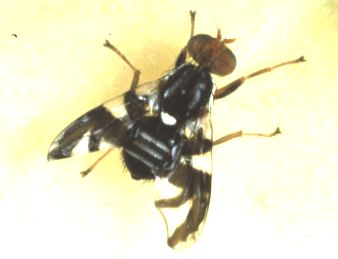
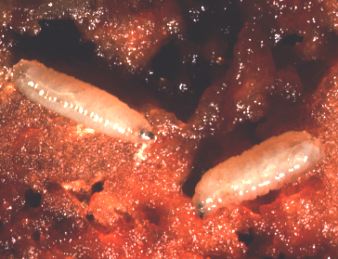
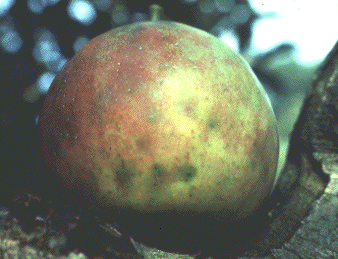
The apple maggot (AM), Rhagoletis pomonella
(Walsh), is an important
pest in the northeastern United States and has recently been
introduced
into the Pacific Northwest. More insecticide is applied annually
in
apple
orchards in northeastern North America to control the AM than
against
any
other single insect pest (Reissig et al. 1983). Populations
seldom
reach
damaging levels in Virginia, but this has become complicated due
to
strict
sanctions made on apples headed for import to Brazil. Previously
apples
could be exported to Brazil after 40 days in cold storage. This
approach
put the US at a disadvantage because once the fruit was released
their
market value had dropped considerably due to competition from
other
countries.
The Brazilian protocol affects growers from California to New
York,
despite
the fact that infestation in the western states has not reached
the
level
it has in the northeast. The Brazilian protocol calls for a very
strict
threshold on AM infestation. It specifies that if one AM adult
is found
in an export block, the fruit for that block will be held at the
packing
house for 14 days. If a subsequent AM is detected within this
period,
the
fruit will be considered infested (Gutierrez, 1996). According
to this
report, infestation is defined as either 1 pupa or larva found
or 2 or
more adults found within the 14 day period within a 1/2 mile of
each
other.
When infestation has been determined, all of the fruit within
the 1/2
mile
area of detection will be considered ineligible for export to
Brazil
for
the remainder of the shipping season. At the packing house the
fruit
that
is to be exported to Brazil will be sampled by very strict and
uniform
guidelines. One hundred apples from each lot will be sampled and
taken
from at least two cartons. Each sample will be examined for
external
injury
and 20 apples will be cut and inspected internally. If AM injury
is
found,
100 apples from other lots of the orchard will be internally
inspected
and if any additional AM are found the shipment will be
rejected. If
the
fruit passes certification it will be shipped directly to the
packing
house
ready for export to Brazil.

The systems approach for monitoring for AM, outlined by the
protocol,
is
divided into two options: High-density trapping and
intensive-insecticide
control programs. The high-density trapping option calls for the
use of
red spheres or yellow panel traps to be placed in the orchard at
1 trap
per 10 acres. They will be monitored throughout the emergence
periods
on
weekly intervals. If AM are detected an insecticide will be
applied
within
seven days and will be followed by two other treatments every
10-14
days.
The intensive insecticide control program method begins with
detection
of AM using trapping or a degree-day model. The pesticide
treatments
continue
on the same spray schedule as the high density trapping option.
This
approach
can be broken down into three different methods. First, low
density
trapping
can occur at the known region of earliest AM emergence and will
continue
through the early emergence period. In this method, all growers
would
base
their timing decisions on regional trapping data. Second,
site-specific
trapping can be implemented where a grower can provide data for
a
particular
orchard. In this approach traps can be placed more frequently in
the
orchard,
40/640 acres vs. 5/640 acres for the low density trapping
method.
Finally,
the degree-day model can be used as an alternative to trapping
to
determine
early AM emergence. Sprays should begin at 900 degree-days above
50oC
starting with January 1, and they should be repeated every 14
days.
The following table contains predicted emergence dates for
several
Virginia counties during the 1996 season. Dates of first
emergence vary
by more than two weeks.
| County | Date of 900 DD |
| Roanoke | 2 June |
| Nelson | 4 June |
| Patrick | 5 June |
| Wise | 9 June |
| Albemarle | 10 June |
| Frederick | 14 June |
| Rockingham | 15 June |
| Montgomery | 15 June |
| Shenandoah | 16 June |
| Madison | 17 June |
The Brazilian protocol has a strict threshold for AM, and
growers need
to be very careful in their methods for monitoring and spraying
their
orchards.
Up to date degree-day data should be kept of the orchard
especially the
date on which 900 degree-days were reached because that is when
spraying
will begin. During trapping, the traps that caught the flies and
the
date
of capture should all be recorded. This could help in later
comparison
with the degree-day data to see how accurate it was in
predicting first
adult emergence and whether more flies were caught on the edge
of the
orchard
or in the center. Finally the spray records should be complete
for
reference
by inspectors enfocing the protocol.
Literature Cited
Gutierrez, N. 1996. US apple certification protocol to Brazil systems approach for apple maggot.
Reisseg, W.H., B.H. Stanley, M.E. Valla, R.C. Seem, and J.B. Bourke. 1983. Effects of surface residues on azinphosmethyl on apple maggot behavior, oviposition, and mortality. Environ. Entomol. 12: 815-821.