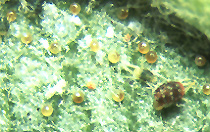
European Red Mite, Panonychus ulmi (Koch)
I. Introduction: The European red mite
(ERM) (Plate 44) is a major tree fruit pest, especially in the
eastern U. S, and is considered by many growers to be their most
important and sometimes most difficult pest to control. The mite
was introduced to North America from Europe in the early l900's
and is now established in most fruit growing areas.
II. Hosts: The ERM will attack a number of different fruit
crops and can cause extensive injury if left uncontrolled, but
apple is usually the most important host. It will also attack
cherry, nectarine, peach, pear, plum, and prune.
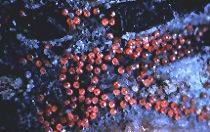
III. Description: The ERM overwinters as a fertilized egg
(Plate 45). It is oval, bright red, and has a small stalk arising
from the top, approximately the length of the diameter of the egg.
Overwintering eggs are deposited in groups on the roughened bark
area, especially around buds and fruit spurs. The summer eggs are
globular, somewhat flattened, and pale green, almost white to
greenish amber when first deposited, but slowly change to a
reddish-orange just before hatch. Six-legged larvae hatch from the
eggs which are initially a pale orange, darkening to a pale green
as they feed. The larvae molt to eight-legged protonymphs which
are variable in color from a pale green to reddish brown with the
dark green predominating. Pale spots at the base of the bristles
are very faint, if present at all. The deutonymphs are variable in
color from an amber color to a dark green, with a dark-green color
predominating. Pale spots are distinct at the bases of the
bristles. The eight-legged adult female mite has a globular body
and is approximately 1/64th inch (0.4 mm) long, bright red to
velvety brown in color, and has four rows of white hairs on its
back. The adult male mite is smaller, has a pointed abdomen, and
the color is straw-yellow to reddish-yellow.
IV. Biology: Overwintering egg hatch in the spring is
closely correlated with apple bud development and first occurs
when 'Delicious' buds are in the prepink stage; hatch continues
throughout the bloom period. The larvae immediately move to the
young foliage and begin to feed. Before the mites transform to
each succeeding stage, they go through a short quiescent period.
Shortly before the adult female emerges, she releases a pheromone
which attracts a male. If mating
ensues, female young are produced; inf a female is unmated, she
produces male offspring. Adult mites usually appear by petal fall.
Female mites live up to an average of 18 days and each female is
capable of laying approximately 35 eggs during her life span. The
rate of development is temperature dependent. Under ideal hot
conditions (average 80*F), a life cycle may be completed in 10 to
12 days, however, a generation normally takes 20 to 25 days to
complete. Eight to 10 generations can occur during a normal
growing season. ERM populations usually peak in July. Females
begin laying overwintering eggs in early to mid-August.
V. Injury: The mites injure the tree by feeding on leaves,
destroying chlorophyll, and increasing respiration. This is
accomplished by the insertion of the mite's mouth parts into the
leaf cells to withdraw the contents. All motile stages feed on the
foliage. The lower leaf surface is preferred, but both leaf
surfaces are attacked when populations are high. All apple
varieties are susceptible to attack, but the mites appear to
increase faster and to higher densities on 'Delicious' and
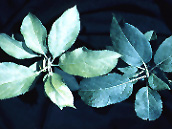
'Yorking'. A characteristic brown foliage, starting as a subtle
cast to the green leaf, but in severe cases becomes bronze,
results from heavy mite feeding. The most serious injury occurs in
late spring and early summer when trees are producing fruit buds
for the following season. Moderate to heavily injured trees (i.e.
with 750 mite days or with 43 motile mites per leaf) produce fewer
and less vigorous fruit buds. Mites feeding on leaves also reduce
their ability to manufacture enough photosynthates for desirable
sizing of fruit. Injury effects from mite feeding are more severe
during periods of drought stress. Late season high populations of
mites can cause further indirect loss of fruit by depositing
overwintering eggs, especially in the calyx end.
VI. Monitoring: From the dormant period up to early pink,
overwintering ERM eggs may be evaluated. Select at random 5-10
trees in an orchard block and inspect small branches using a
magnifier. Close attention should be given to the bases of twigs
and spurs.
If no oil application or other acaricide were applied prior to
bloom, then monitoring should begin during the bloom period.
Select 5-10 trees of the same cultivar (e.g. `Delicious',
`Stayman' or `Yorking') randomly scattered throughout the block.
Collect 5-10 leaves of middle age (i.e., from the middle of a
fruit spur) and examine each leaf for the presence or absence of
one or more motile mites. After examining all leaves, determine
the percentage of mite-infested leaves. Refer to Table 2 and
select the expected number of mites per leaf for a given
percentage of mite-infested leaves. If an oil application were
made prior to bloom, the first sample for motile mites can
usually be delayed until early to mid June. The same procedure
should be followed. After an acaricide application is made, this
method of monitoring mites is not as reliable. A direct count of
the motile mite population is necessary. Examine the same cultivar
and number of trees as before, but count the total number of
motile mites on each leaf. Mite populations should be monitored on
a weekly basis, especially during periods of rapid buildup. See
the Univ.
Maine link on sequential sampling for ERM.
Once pest mites [e.g., ERM and twospotted spider mite (TSM)] and
natural enemy populations are determined, it is important to
incorporate the economic impact of mite management into the
decision-making process. Variables such as time of season, crop
load, and miticide costs and efficiency should be considered,
along with mite, Stethorus and predatory mite counts. The
degree of mite injury to a leaf is affected not only by the
density of mites per leaf but also by the number of days a given
density of mites is allowed to feed. Thus, the term "mite days" is
defined as the product of the number of mites per leaf multiplied
by the time they are present (e.g., 5 mites per leaf for 5 days
equals 25 mite days per leaf). Since growers think in terms of
mites per leaf rather than mite days per leaf, a mathematical
relationship has been determined between mite days and motile
mites per leaf. Therefore, mites per leaf may be used to make
decisions about mite control (see second Table). Based on the
relationship of mites per leaf and mite-days, action thresholds
have been developed by Penn State University to aid in making mite
management decisions. The
following graph includes mite action thresholds for various
crop loads at different times of the growing season. To use this
figure, determine the number of mites per leaf based on the
previous monitoring instructions for both pest mites and Stethorus
populations. Next, estimate the projected production per acre
(harvested bushels) for the affected block. Select the threshold
line on the figure for the appropriate time of the growing season.
For a given time of the growing season and a given estimated crop
load, if the mites per leaf exceed the threshold then some control
mechanism is needed-either control by Stethorus or by
application of miticides. If you are using the alternate
row-middle system of spraying to make your miticide applications,
reduce the action threshold to one-half the figure value since you
are only spraying one-half of the tree. These levels apply to
healthy, vigorous trees with mite damage occurring only after June
1. If the mite population does not exceed the action threshold,
the mite population should be reassessed within 1-2 weeks.
Table 2. European red mite densities predicted from the percentage
of mite-infested leaves.
Percentage of...............Expected density....... .Limits of
mite
infested leaves1............in mites/leaf...............pop. in
mites/leaf2
40...............................0.7...........................0.25
- 1.20
45...............................0.9...........................0.35
- 1.45
50...............................1.1...........................0.45
- 1.75
55...............................1.3...........................0.60
- 2.15
60...............................1.6...........................0.80
- 2.65
65...............................2.0...........................1.05
- 3.25
70...............................2.6...........................1.35
- 4.10
75...............................3.4...........................1.85
- 5.35
80...............................4.7...........................2.55
- 7.25
85...............................6.8...........................3.85
- 10.55
90..............................11.4...........................6.50
- 17.55
95..............................26.4..........................15.30
- 40.30
1 Leaves with at least one motile stage. 2 95% confidence
interval.
Table 3. Relationship between number of European red mites per
leaf at their peak and accumulated number of mite days per leaf.
Peak number......Expected number.........Expected limits of
of mites/leaf......no. of mite days..........no. of mite days1
5......................88........................0 - 332
10....................176........................0 - 420
15....................263.......................10 - 507
20....................351......................107 - 595
25....................439......................195 - 683
30....................527......................283 - 771
35....................615......................371 - 859
40....................702......................458 - 946
45....................790......................546 - 1034
50....................878......................634 - 1122
1 95% confidence interval - there is only a 1 in 20 chance of the
accumulated mite-day value falling outside this range.
If the mites per leaf exceed the action threshold, the Stethorus population should be
assessed by determining a predator-to-mite ratio. To calculate
predator-to-mite ratios, divide the number of Stethorus
adults and larvae counted in 3 minutes by the number of motile
mites per leaf. Example: 25 Stethorus adults and larvae
divided by 10 motile mites per leaf equals a predator-to-mite
ratio of 2.5. If the predator-to-mite ratio is less than 2.5 and
the action threshold has been reached, then a miticide application
is justified. The orchard should be checked again in 5 to 7 days.
Amblyseius populations can be
monitored at the same time growers are scouting for spider mites
since they occupy the same habitat. Initial populations in the
spring may be assessed by selecting 10 apple leaves from suckers
beneath each of 10 randomly selected trees in a block. Examine the
surface for Amblyseius moving across the leaf surface.
Research in Michigan on this mite system has yielded tentative
thresholds for predicting success of biological control by Amblyseius.
A ratios of predators to prey of at least 1:10 presents a good
probability of biological control; higher ratios increase the
probability of success. Lower predator:prey ratios (e.g. 1:20) may
result in successful control on some apple varieties less
conducive to spider mite reproduction than `Red Delicious'. If
high populations are found in late season, ground cover
management, particularly herbicide selection in the fall and the
following spring, should take Amblyseius into
consideration. There are no thresholds available for ground
cover/sucker counts.
Zetzellia populations can also
be monitored at the same time growers are scouting for the
European red mite and twospotted spider mite. There are no
validated management thresholds for Zetzellia; however,
populations averaging 2-3 motile Zetzellia per leaf can
cause phytophagous mite populations to decline.
See New
Zealand photos.
This is taken primarily from a chapter by
D.G. Pfeiffer, L.A. Hull, D.J. Biddinger, & J.C. Killian on
apple indirect pests, reprinted with permission from Mid-Atlantic
Orchard Monitoring Guide, published by NRAES, 152 Riley-Robb
Hall, Ithaca, New York 14853-5701.
Additional Reading:
- Hull, L. A. and E. H. Beers. 1990.
Validation of injury thresholds for European red mite (Acari:
Tetranychidae) on 'Yorking' and 'Delicious' apples. J. Econ.
Entomol. 83: 2026-2031.
- Marini, R. P., D. G. Pfeiffer and D. S.
Sowers. 1994. Influence of European red mite (Acari:
Tetranychidae) and crop density on fruit size and quality and
on crop value of 'Delicious' apples. J. Econ. Entomol. 87:
1302-1311
- Mobley, K. N. and R. P. Marini. 1990. Gas
exchange characteristics of apple and peach leaves infested by
European red mite and twospotted spider mite. J. Am.
Soc.Hortic. Sci. 115: 757-761.
Back to Virginia
Apple Page
Back to Home Page for "Arthropod Management
in Fruit Crops" course
Back to Virginia
Fruit Page
Maintained by: Douglas
G. Pfeiffer
Department of Entomology
Virginia Tech
Blacksburg