This is adapted after:
Pfeiffer, D. G.2008.Major insect and mite
pests of grapes. p. 241-261, 307-311. In: T. K. Wolf (ed.)
Wine Grape
Production Guide for Eastern North America.Natural Resource, Agriculture, and Engineering Service
Pub;. 145,
Cornell.
(http://palspublishing.cals.cornell.edu/nra_order.taf?_function=detail&pr_id=178&_UserReference=0E03A)
This eriophyid mite is very small and
probably won't be seen without magnification. It overwinters
beneath loose bark of one-year old canes. There are three strains
reported: the bud strain, the erineum strain, and the leaf-curling
strain. Feeding by the bud strain on buds of susceptible
varieites injures the bud cluster, distorts basal leaves
(developing apical leaves are deeper in the bud, and are less
likely to be injured at this time), and may kill the overwintering
buds. In spring, mites move to leaves where they cause a
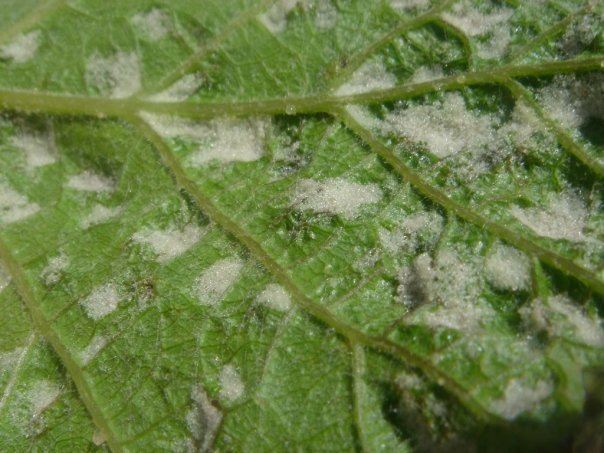
gall-like "erineum" (mite-induced growth of leaf surface hairs or
erinea) on the upper leaf surface. On the lower surface, beneath
the erineum, is a dense, white growth of abnormally
curled plant hairs. Mites feed and reproduce in this patch
of hairs. Some varieties reportedly support populations fo
grape erineum mite without developing the leaf erineum
symptom. Some leaf distortion is tolerable, and control may
not be needed unless injury is extensive (UCal;
Univ.
Cal. Integrated Viticulture). In light infestations, removal of
galled leaves may provide some control. Best time for
control is when shoots are growing or when erinea are
forming. Sulfur provides some control (wettable sulfur
more so than flowable sulfur); mildew sprays incorporating
sulfur aid is suppressing grape erineum mite. A
threshold developed in Oregon calls for treatment with Envidor
(spirodiclofen) when 50% of shoots have 50% of leaves with mites
(inspect with a hand lens). Nexter (pyridaben) or Movento
(spirotetramat) may also be applied. When mites have
retreated to beneath bud scales, control is difficult.
Other reading:
Jeppson, L. R., H. H. Keifer, & E. W. Baker. 1975. Mites
Injurious to Economic Plants.Univ. of Calif. Press, Berkeley.614
p. 74 pls.