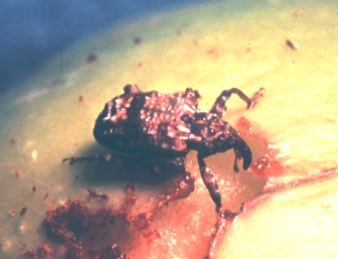
 Plum
Curculio,
Conotrachelus
nenuphar (Herbst) in Peach
Plum
Curculio,
Conotrachelus
nenuphar (Herbst) in Peach
I. Introduction: The plum curculio (PC)
was
described
under the apple
section, but injury and monitoring are somewhat different with
stone
fruits.
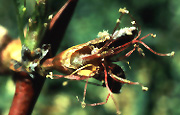
II. Injury: Adults first feed on
developing
buds, flowers, shucks, and setting fruit. Adults will often feed
on the
developing shuck (left photo below) and young peach during the
bloom to
petal fall periods. Egg-laying scars are the most common injury
and
will
be most easily found on fruit from outside rows near
overwintering
sites.
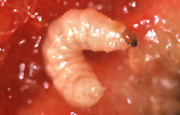
Larvae (right photo below) tunnel into developing fruit and feed
near
the
pit. First brood larval injury will cause fruit drop. Second
brood
injury
will usually not cause drop, but will provide a wounded fruit
source
for
brown rot and other diseases to develop.
III. Monitoring: Monitoring of PC
should
be
concentrated from bloom through two weeks after shuck-fall.
Monitoring
can be done with a beating tray by holding a large square yard
cloth
beneath
the tree and beating on a branch three times with a rubber
mallet or
rubber-wrapped
stick. Fruit should also be examined by counting a minimum of
200 fruit
per block for egg-laying scars or feeding injury. Early control
of the
overwintering generation is critical so that egg laying is
avoided.
Additional monitoring for the second adult PC
emergence
should be done during July. Monitoring can be done with a
beating tray
by holding a large square yard cloth beneath the tree and
beating on a
branch three times with a rubber mallet or rubber-wrapped stick.
Fruit
should also be examined by counting a minimum of 200 fruit per
block
for
egg-laying scars or feeding injury.
No economic threshold levels have been
established.
However since PC is a direct pest, no more than 1/2 to 1 percent
fruit
injury should be tolerated.
(A note on plum curculio strains. There are
two
strains of plum curculio. The northern strain has an obligatory
chilling
requirement. Therefore there is a single generation per season.
The
southern
strain lacks this chilling requirement and can develop two
generations
seasonally. A rough
map showing the distribution of the northern (single-brooded) and
southern (double-brooded) strains was developed by Chapman (1938).
There are genetic differences among geographic strains of PC (Zhang et
al. 2008). Furthermore, there are Wolbachia
symbionts in PC, also with geographical differences in
their
genetics (Zhang et al. 2010). These differences in Wolbachia infections likely
result
in observed differences in mating within and among PC strains (Zhang
and
Pfeiffer 2008).)
Zhang,
X., S.
Luckhart,
J.
Tu
and
D.
G.
Pfeiffer. 2010. Analysis
of
Wolbachia
strains
associated with Conotrachelus
nenuphar (Coleoptera:
Curculionidae) in the eastern United
States. Environ. Entomol. 39: 396-405.
Zhang,
X., J. Tu, S. Luckhart and D. G. Pfeiffer. 2008. Genetic
diversity of plum curculio, Conotrachelus
nenuphar (Herbst) (Coleoptera: Curculionidae) among
geographical populations in the eastern United States.
Ann. Entomol. Soc. Am. 101: 824-832.
Zhang,
X.,
and
D.
G.
Pfeiffer. 2008. Evaluation
of reproductive compatibility of interstrain matings
among plum curculio populations in the eastern United
States. Environ. Entomol.
37: 1208-1213.
This is taken primarily from a chapter by D.
F.
Polk, H. W. Hogmire
and C. M. Felland on peach direct pests, reprinted with permission
from
Mid-Atlantic
Orchard Monitoring Guide, published by NRAES, 152 Riley-Robb
Hall,
Ithaca, New York 14853-5701. (607) 255-7654.
Back to Stone
fruit
page
See factsheets from Ohio,
Kentucky,
Michigan,
New
York, Texas,
and
management
guidelines
from Arkansas
Back to Mid-Atlantic
Regional
Fruit Loop