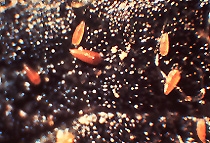
Apple Rust Mite, Aculus schlechtendali (Nalepa)
I. Introduction: Apple rust mite (ARM)
is a
tiny mite living an apple foliage. This eriophyid lives
in apple orchards world-wide. Although more abundant in unsprayed
trees, it is common in managed blocks. High
population densities can cause injury, but more usual populations
are
beneficial because ARM is an alternative
food source for the predatory mite, Amblyseius
fallacis, and the black
hunter thrips, Leptothrips mali.
II. Hosts: Apple, including crabs, and possibly pear.
III. Description: ARM are elongate triangular mites, pale
yellow
or off-white in color
(Plate 49). They are barely discernible using a hand lens (7/1000
inch;
160-175 microns long, ca. 0.2
mm). ARM possess only two pairs of legs (mites generally have four
pairs).
IV. Biology: Winter-form females overwinter in dormant buds
and
under loose bark on 1-year-old
shoots. Mites move into fruit buds between tight cluster and pink,
and
into vegetative buds as they
swell. Mites feed on flower receptacles and fruitlets in May and
June.
Females deposit eggs on the
undersides of leaves, giving rise to males and summer form
females.
There are several generations before
winter-form females appear in July, possibly in response to the
hardening of buds. These females return
to overwintering quarters at this time. Presence of apple rust
mites
can condition foliage so that it is
less suitable for development of ERM.
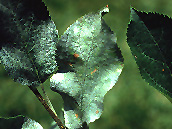
V. Injury: ARM can cause a silvering of foliage (Plate 50),
although population densities seldom
reach damaging levels. If populations are very high, however,
terminal
growth will be affected and leaves
will curl lengthwise and turn brown. ARM may feed on young fruit
in May
and June, damaging the epidermis and
causing russeting.
VI. Monitoring: To assess summer populations, examine
leaves
with a hand lens. Although it is
impractical to obtain accurate population counts with this method,
if
many are seen, consider more intensive
sampling, ideally with a dissecting microscope. When concerned
with
russet, sample overwintering populations
by examining under bud scales under magnification. Below these
levels
ARM is actually beneficial because it
is an alternative food source for predatory mites. There is no
threshold available for overwintering
populations beneath bud scales.
This is taken primarily from a chapter by
D.G.
Pfeiffer, L.A. Hull, D.J. Biddinger, & J.C. Killian on apple
indirect pests, reprinted with permission from Mid-Atlantic
Orchard
Monitoring Guide, published by NRAES, 152 Riley-Robb Hall,
Ithaca,
New York 14853-5701.
Back to Virginia
Apple
Page
Back to Home Page for "Arthropod Management
in
Fruit Crops" course
Back to Virginia
Fruit
Page